
Atmosphere Notes
The Governance Gap Killing Your AI Strategy
Why 74% of companies are deploying agentic AI while only 21% have mature governance, and what leaders must do before enforcement catches up
Most organizations are racing to deploy autonomous AI agents without the governance infrastructure to keep them accountable. This gap between deployment speed and control maturity is becoming the single biggest risk factor for enterprise AI initiatives in 2026.
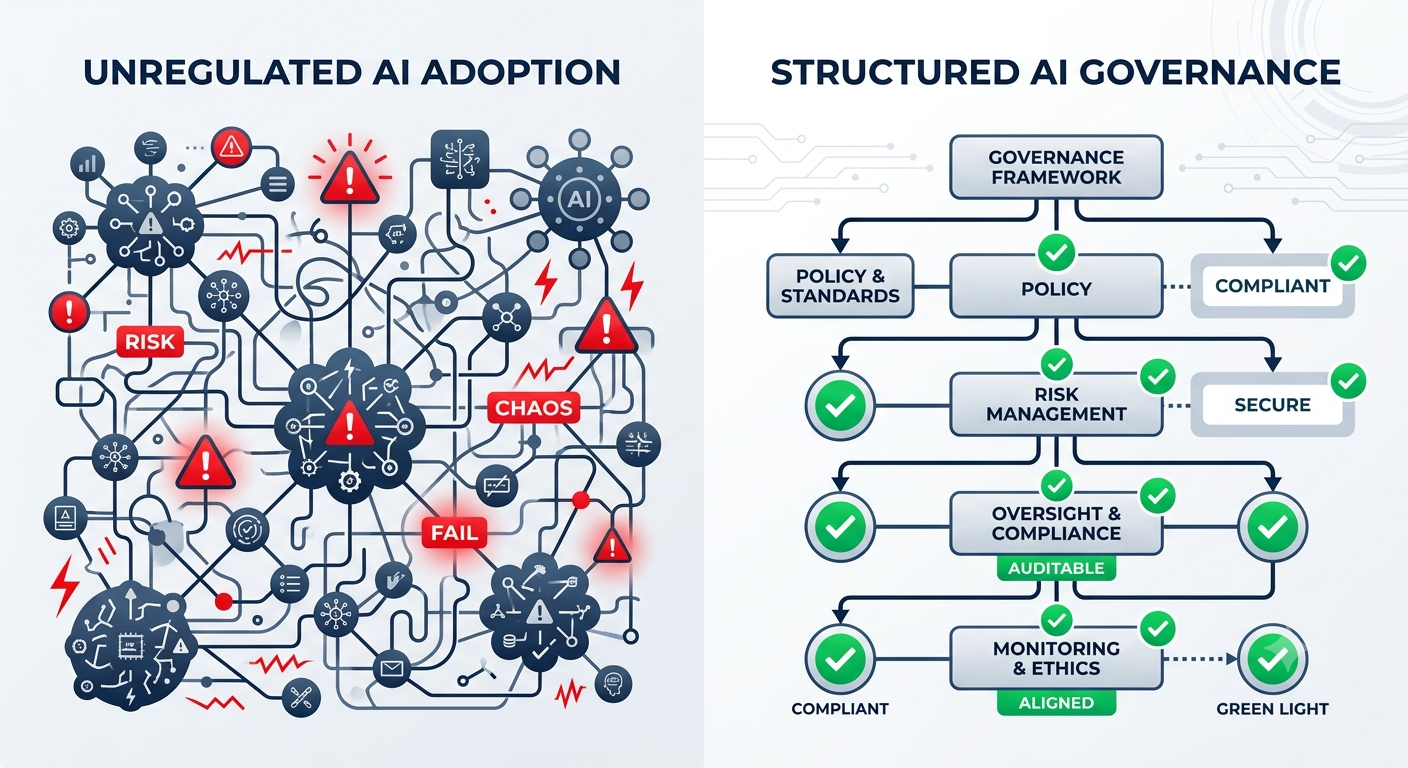
August 2, 2026 marked a turning point. The EU AI Act's transparency requirements became legally enforceable that day, transforming AI governance from advisory best practice into statutory obligation. Organizations worldwide now face active audit mandates, penalty regimes, and compliance deadlines that cannot be ignored.
Yet here's the uncomfortable reality. Deloitte's State of AI in the Enterprise report reveals that 74% of companies plan to deploy agentic AI within two years. Only 21% report having a mature governance model for autonomous agents. That's a 53-point gap between ambition and readiness.
The enforcement era has begun
Regulators stopped asking whether AI should be governed months ago. They're now defining exactly how organizations must deploy, monitor, and control AI systems in practice. The EU AI Act crossed its most consequential threshold this year, with high-risk AI obligations becoming enforceable as of August 2026. Stand-alone high-risk systems face rules from December 2027, while high-risk AI incorporated into regulated products follows in August 2028.
California's SB 1047 deadline arrived in September 2026 alongside Brazil's Senate vote on AI legislation. China's CAC inspections are underway. India is weighing comprehensive AI legislation. The regulatory landscape shifted from preparation to active statutory enforcement across multiple jurisdictions simultaneously.
This isn't theoretical anymore. Fines are being issued. Audits are happening. Organizations are discovering that shadow AI and uncontrolled third-party models create liability exposure they never priced into their AI strategy.
Why governance maturity lags deployment speed
The disconnect makes sense when you examine how AI adoption actually unfolds. Product teams move fast. They experiment with agentic workflows, deploy autonomous agents, and integrate AI capabilities into customer-facing systems. Speed creates competitive advantage. Governance feels like friction.
Most responsible AI initiatives remain stuck at the principles and checklists stage. Organizations publish thoughtful AI ethics guidelines, form oversight committees, and conduct point-in-time reviews. These measures look good on paper. They don't create continuous, evidence-based control over AI systems operating in production.
Gartner's first Magic Quadrant for AI Governance Platforms, published June 2026, identified the market shift explicitly. Organizations are moving from high-level principles to operational enforcement. Evidence generation, audit-ready reporting, and measurable controls became non-negotiable requirements almost overnight.
Spending on AI governance platforms is projected to reach $492 million in 2026 and surpass $1 billion by 2030. This isn't compliance theater. It's infrastructure investment for an environment where AI systems operate autonomously and regulators demand traceable accountability chains.
The three capabilities you need now
Full AI estate visibility. You cannot govern what you cannot see. Continuous discovery and centralized inventory of every model, application, agent, and related data asset forms the foundation. Shadow AI remains a major risk vector. Uncontrolled third-party models create compliance blind spots that auditors will find.
Agentic AI governance. Autonomous and multi-agent systems require different controls than static models. Agent discovery, policy inheritance across agent hierarchies, and traceable accountability chains differentiate mature governance programs from checklist exercises. Your governance framework must handle agents that make decisions, take actions, and interact with other agents without human intervention.
Regulatory mapping and compliance automation. Platforms must map controls to major frameworks including the EU AI Act, NIST AI RMF, and ISO/IEC 42001. Automated regulatory mapping and continuous compliance evidence generation are now key buying criteria. Manual documentation processes cannot keep pace with enforcement timelines.
The consulting opportunity in the gap
This governance gap creates a specific consulting opportunity. Organizations need help translating regulatory requirements into operational controls that don't cripple innovation velocity. They need frameworks that embed governance directly into AI development and deployment pipelines rather than bolting it on afterward.
The convergence of AI governance with broader GRC, risk, and compliance systems is accelerating. AI governance can no longer operate as a standalone silo. It must integrate with existing enterprise risk management infrastructure while maintaining the agility that AI development requires.
Leaders who treat governance as a strategic enabler rather than a compliance burden will scale AI with confidence. Those who delay will face enforcement actions, reputational damage, and the much higher cost of retrofitting governance into production systems under regulatory pressure.
The window for proactive governance architecture is closing. August 2026 was the beginning, not the end. Your AI strategy is only as strong as your governance foundation.
Found this useful?
Whether you are building something, rethinking something, or looking for the right people and perspective around you, Spadosphere is designed to meet you there.